
Handwriting vs Calligraphy: What’s the Difference?

Handwriting and calligraphy are both forms of writing done by hand, so how are they different?
If you’ve ever asked that question, this post is for you! I’m going to break down the differences between calligraphy and handwriting so you can see how the two compare.

Handwriting vs calligraphy
Despite the (sometimes confusing) terminology out there, handwriting and calligraphy are not exactly the same.
Both are forms of writing done by hand, but the methods used and the purpose of each is different.
Here’s a brief look at what both handwriting and calligraphy are defined as…
What is handwriting?
Handwriting just means “writing done by hand,” or it can refer to someone’s style of handwriting.
The purpose of handwriting is to communicate or record information. It’s the writing we use every day for all sorts of purposes.
Of course, everyone has their own style of handwriting, whether it’s cursive, print, or a mix.
Words are often written without ever lifting the pen from the paper, which allows for fast writing and flow of thought.
What is calligraphy?
Calligraphy is the art of beautiful writing using a pressure-sensitive tool, like a brush pen. The goal is to write beautifully, not quickly.
Calligraphy letters are written by combining a series of foundational shapes, usually called the basic strokes. If you can form those shapes, you can do calligraphy!
Want to learn calligraphy?
Read my free guide on how to start doing calligraphy as a beginner. It covers everything you need to know to get started!
So yes: calligraphy IS technically handwriting in the sense that it’s “writing done by hand.”
But it’s also much more than your typical handwriting!
Calligraphy is a special art form of its own. It takes more time, more precision, and more effort than everyday handwriting. It also usually requires special pens.
Here’s a table showing the differences between everyday handwriting and calligraphy.
| Tools | Purpose | Method | Appearance | |
|---|---|---|---|---|
| Handwriting | Any writing utensil | Writing quickly and legibly to communicate | Often continuous writing for increased speed | Can be cursive, print, or a mix of both |
| Calligraphy | A pressure-sensitive writing tool | Writing beautifully | Letters broken down into small strokes | Thick and thin strokes, connected letters, sometimes flourishes |
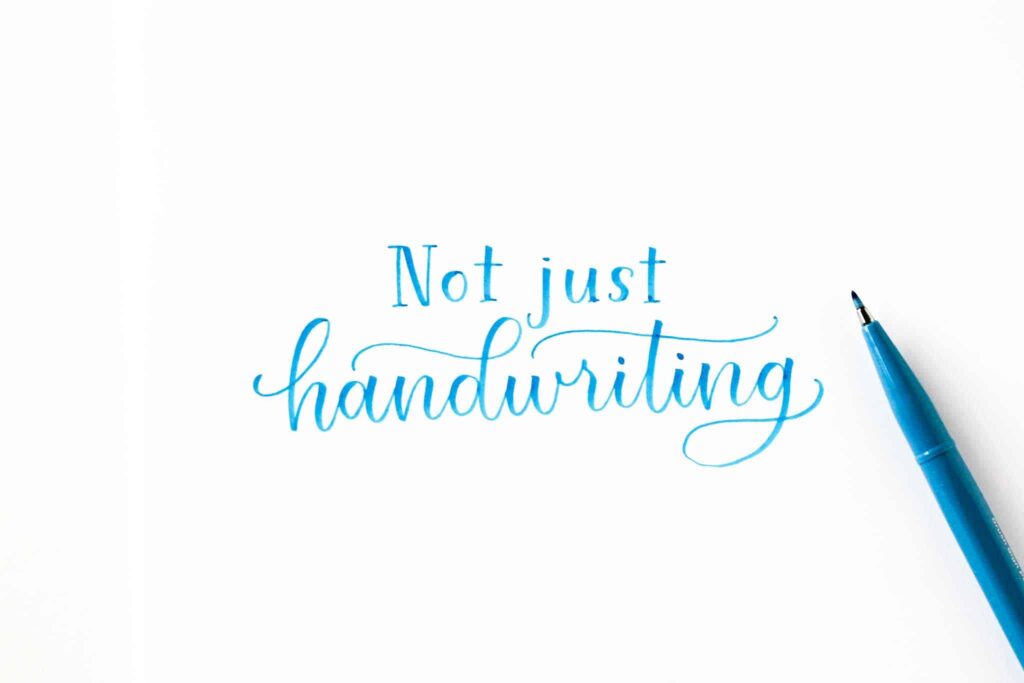
Cursive vs. calligraphy
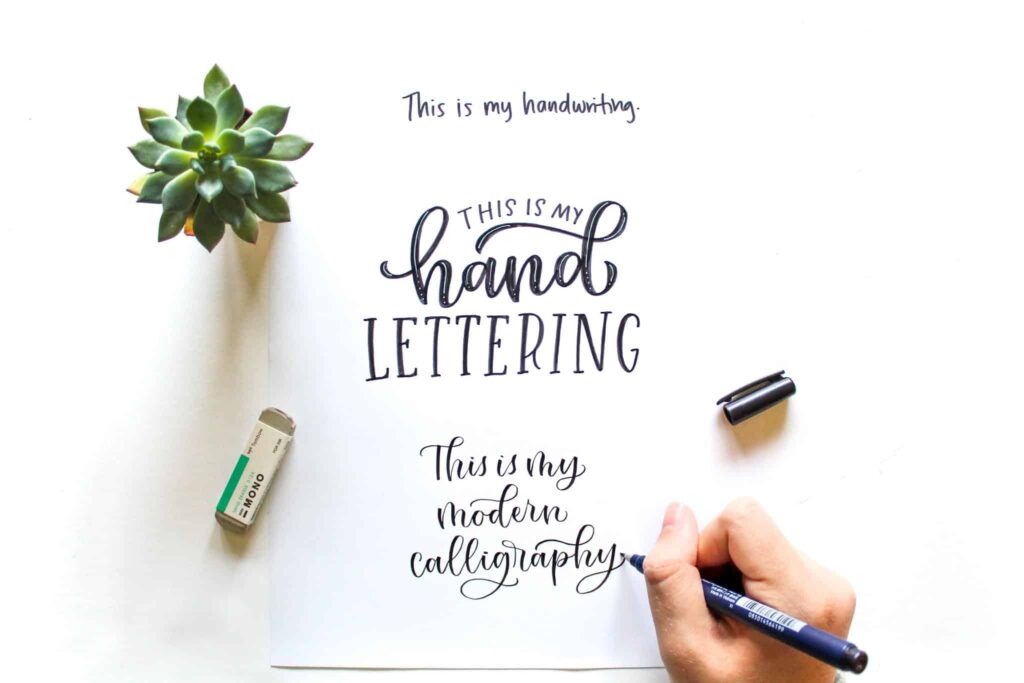
Cursive writing can look very similar to calligraphy. At first glance, they might look like the same thing, but they’re not.
With cursive, you keep your pen on the paper and write fast and continuously. With calligraphy, you’re picking up the pen after nearly every stroke!
Calligraphy letters are broken down into little shapes and strokes so you can write them with precision. (This is why calligraphy is SO much slower.)
The purpose of calligraphy is to write beautifully, so it takes more time to write neat strokes. We lift the pen after each stroke, unlike cursive, because the goal is beautiful writing instead of speed.
That said, cursive can be an art form all its own!
You don’t need to know cursive to learn calligraphy. The two are similar in some ways, but the writing process is not the same.
Can a person write in calligraphy as their everyday handwriting?
No, I don’t know of anyone who uses calligraphy as their everyday writing. It’s just not practical, since calligraphy takes much longer!
Calligraphy videos on social media are sped up a lot. In reality, calligraphy is written very slowly. If the videos were real-time, you’d get bored very quickly. Calligraphy is not a fast way to write.
It’s perfect for adding a special touch to handwritten notes, envelopes, cards, and so many other things. It can also be fun to practice your calligraphy by writing out everyday things with it.
But if someone were to use calligraphy for all their writing needs, it would be very time-consuming.
Do you need good handwriting to do calligraphy?
Good news: you do not need good handwriting to do calligraphy! Your handwriting doesn’t have much of an effect on calligraphy skills.
The process for writing calligraphy is totally different from your regular writing.

Calligraphy letters are broken down into little shapes called the basic strokes.
All you need to do is learn those basic strokes and you can put them together to create the calligraphy alphabet. Nowhere is neat handwriting required.

Good handwriting doesn’t automatically make you good at calligraphy, and bad handwriting doesn’t make you bad at calligraphy, either!
Many calligraphers have messy handwriting and still do beautiful work. If you want to learn calligraphy, don’t let your handwriting stop you.
Head over to this free guide to get started!
Does calligraphy improve handwriting?
Yes, it’s possible that calligraphy will help improve your everyday writing, but learning calligraphy will not automatically improve your handwriting.
Learning calligraphy helps you be more mindful of things that will improve the consistency of handwriting, but it’s sort of up to you whether or not you want to apply these things to your regular writing.
If you’re looking for ways to improve your handwriting, here’s a helpful blog post with tips to improve handwriting over at the Postman’s Knock blog.
Is calligraphy a skill or a talent?
Calligraphy is a learned skill, not a natural talent.
Anyone can learn calligraphy by consistently practicing the strokes. While it takes some time to master, it’s not a hard skill to learn. It’s pretty easy to pick up a pen and start learning calligraphy!
A person can go from no experience (and messy handwriting) to doing beautiful calligraphy simply by practicing consistently over time.
It’s easy to look at someone’s work and think, “Wow, they are so talented! I could never do that.” Someone who’s been doing calligraphy for ten years makes it look effortless, so we assume they just have a natural talent that we don’t have.
But the fact is, while some may have natural talent in a certain area, the skill still had to be practiced before it developed into what we see now.
There is so much effort, practice, mistakes made, and learning that goes into any skill, and these are things that many people never see.
As Bob Ross said, “Talent is a pursued interest. Anything that you’re willing to practice, you can do.”
Further reading:
How to Learn Calligraphy as Beginner
8 Ways to Make Your Handwriting Look Fancy
How to Do Calligraphy with ANY Pen!

